Introduction
The Healthcare and Life Sciences (HLS) industry is a critical sector for Microsoft, encompassing services and products that are aimed at maintaining and improving health. This industry includes the following components:
Providers of diagnostic, preventative, remedial, and therapeutic services
Medical technology and equipment manufacturers
Pharmaceutical and life sciences manufacturers
Health payor and insurance companies
Microsoft uses the data standards that are important to healthcare. Every organization needs to safeguard their business, customers, and data, particularly in this era of AI. Microsoft for Healthcare functions with trust in mind, helping every organization build safety and responsibility into their AI journey from the beginning.
Key Challenges in Healthcare
Healthcare is facing significant change. It’s imperative that the industry adapts and responds to this changing landscape.
In recent years, healthcare organizations are burdened with an unprecedented volume of challenging moments that forced many to rethink established norms and operational best practices.
Examples of pressures that the industry faces include:
Higher patient expectations
Workforce burnout
Increasing data volume
Constant pressure for innovation

More specifically, healthcare organizations face these challenges:
Expectations are higher than ever for patient and member engagement - As technology becomes more ubiquitous, many patients and members want new opportunities for managing their health. Today, 70% of patients and members prefer digital solutions for all major aspects of their care journey.
Health workforce burnout and talent shortages - Burnout is reached crisis levels. Moreover, burnout with health workers has harmful consequences for patient care and safety. The consequences include decreased time spent between providers and patients, increased medical errors, and a shortage of workers as a result of clinicians leaving the profession. Surveys show that between 35-54% of clinicians are suffering burnout. Researchers project a shortage of 10 million frontline healthcare workers worldwide by 2030. Additionally, researchers estimate that annual burnout-related turnover costs are 9 billion dollars for nurses and 2.6 to 6.3 billion dollars for physicians. These estimates don't include turnover among other types of health workers across the continuum of care.
Effective use and interpretation of data insights - The problem isn’t a lack of data, it’s a lack of interoperability and integration across data systems. Today, hospitals produce over 50 petabytes of data across upward of 10 siloed systems every year. With such large volumes of unstructured data, providers must spend an exorbitant amount of time trying to glean insights from that data. In fact, up to 97% of data goes unused. This unused data stands as a major barrier to improving operational efficiency, ensuring high quality standards, and reducing costs.
Security pressures - Security and patient privacy risks are rising. For the fourteenth year in a row, healthcare had the highest average data breach cost of any industry. In 2024, healthcare data breaches came with a hefty price tag, to the tune of 9.77 million dollars. This fiscal year, 389 US healthcare institutions were hit by ransomware. This ransomware caused network shutdowns, offline systems, delays in critical medical procedures, and rescheduled appointments. The attacks are costly, with one industry report showing healthcare organizations losing up to 900,000 dollars each day on downtime alone.
Financial integrity - The COVID-19 pandemic created a sharp and immediate reduction in elective and nonessential surgeries, a major revenue driver for many hospitals, forcing administrators to reconsider healthcare economics for the long term. Estimated hospital losses are at 54 billion dollars, with a 26.7% operating margin decline year-over-year. Immense pressure is placed on health organizations to find more efficient ways of working to bring the system-wide costs down.
Addressing these pressures while lowering costs is a societal issue, and it's important for Microsoft to contribute and address these issues.
For more information, see the following resources:
- McKinsey & Company
- Addressing Health Worker Burnout and Covid has made it harder to be a health-care worker
- World Health Organization
- Cost of a data breach 2024 | IBM
- “TRANSCRIPT: House Committee Hearing to Assess Microsoft’s Cybersecurity Shortfalls” Tech Policy Press, June 15, 2024
- “On average, healthcare organizations lose 900,000 dollars per day to downtime from ransomware attacks,” Comparitech, March 6, 2024
- Healthcare Financial Trends for 2022
- World Economic Forum
- The HIPAA Journal: Average cost of healthcare data breach reaches 11M dollars report finds | Healthcare Dive
Introduction to Microsoft for Healthcare
The key in addressing these healthcare challenges is to empower the healthcare industry and work with healthcare organizations to make a difference. Microsoft is dedicated to helping create an efficient and connected healthcare ecosystem. Bringing the healthcare ecosystem together empowers everyone across the healthcare journey to collaborate, communicate, and innovate together in providing better experiences for their workforces and patients or members.
Microsoft is making deep investments in healthcare to create an efficient and connected healthcare ecosystem. It's bridging data, AI, and trust across the entire healthcare ecosystem.
Microsoft is invested in key solutions in the following segments:
Provider
Payor
Pharma / MedTech

Microsoft is committed to helping you achieve more in healthcare with investments across the following key areas:
Dedicated engineering and research teams - Dedicated engineering and research teams that can scale to ensure that you're at the leading edge of the industry.
Industry‑leading responsible AI - Microsoft invests in industry-leading, responsible AI, including the acquisition of Nuance and investments in OpenAI.
Industry-specific partner ecosystem and expertise - A robust ecosystem of partners specializing in healthcare who can support you with their expertise and powerful solutions.
Trusted global security, privacy, and compliance commitment - Microsoft is committed to being an organization that you can trust, with global security, privacy, and compliance built into everything. Security and privacy are top priorities because Microsoft runs on trust.
Trustworthy AI
Unlocking human potential starts with trust. Trustworthy AI is a key pillar of Microsoft's commitment to security, privacy, and safety. Trustworthy AI is only possible when we combine our commitments with our product capabilities to help customers unlock AI transformation with confidence.
The commitments to trustworthy AI are:
Security - The top priority for Microsoft, with a commitment to helping customers protect their data and systems. Microsoft has been investing in security for more than 20 years. The Secure Future Initiative (SFI) that launched in November 2023 underlines the company-wide commitments and the responsibility of making our customers more secure. The first SFI Progress Report highlights the updates that span culture, governance, technology, and operations.
Privacy - Data is at the foundation of AI, and Microsoft’s priority is to help ensure that customer data is more protected and compliant through our long-standing privacy principles, which include user control, transparency, and legal and regulatory protections. The Microsoft commitment to privacy involves:
Giving you control of your data along with choices on how your data is used.
Protecting your data through rigorous means of protection, including encryption and other security best practices.
Designing products with privacy in mind and focusing on upholding user privacy.
Standing up for your rights and fighting for stronger privacy laws and protections.
Safety - The commitment of safety is inclusive of security and privacy. Microsoft’s broader Responsible AI principles, established in 2018, continue to guide how we build and deploy AI safely across the company. Microsoft’s Responsible AI framework ensures building, testing, deploying, and monitoring AI with our six AI principles at the center. This framework helps avoid undesirable behaviors, such as harmful content, bias, misuse, and other unintended risks.
Over the years, Microsoft made significant investments in building the necessary governance structure, policies, tools, and processes to uphold these principles and build and deploy AI safely. Microsoft is committed to sharing the learnings on this journey of upholding our Responsible AI principles with our customers.
These commitments coincide with our healthcare capabilities to strengthen the security, safety, and privacy of AI systems to make sure that our customers and developers are protected at every layer.
Microsoft Cloud for Healthcare
Microsoft for Healthcare is a unique approach to empower healthcare customers and partners to innovate with AI responsibly at every layer of the cloud. From cloud infrastructure to data and AI, security surrounds everything that people do.
Microsoft for Healthcare helps our customers innovate responsibly at every layer of the cloud. Microsoft for Healthcare provides trusted, integrated, and powerful capabilities that help make it easier for organizations to:
Safeguard people, health data, and infrastructure.
Empower the healthcare workforce.
Enhance patient and member experiences.
Unlock value from clinical and operational data.
Accelerate research, discovery, and development.
Together with Microsoft and our partners, your organization can use AI that combines multiple sources to give full visibility into data and improve process and workflow automation. This approach helps relieve administrative burdens and create actionable insights that deliver better care faster and at a lower cost.
Microsoft for Healthcare in AI Era
Other reports indicate that an integrated generative AI strategy to transform business operations has the potential of driving a 15% to 40% improvement in bottom-line economic results for a provider. For more information, see Harnessing Generative AI in Healthcare.
By embracing built-in AI in the tools that you’re already using, you can radically accelerate employee productivity, creativity, efficiency, and innovation across your entire organization. As a result, you can:
Empower every employee with new experiences and capabilities in the tools that they use every day.
Create more targeted solutions that empower healthcare business functional roles, such as clinical teams, claims analysts, or research scientists.
Empower the security and IT professionals and developer and data professionals who are behind the scenes but are critical to your success.
Making AI accessible to everyone helps create exciting opportunities that help drive real impact across the healthcare value chain.
Innovate by using AI responsibly
Microsoft for Healthcare is a unique approach to empower healthcare customers and partners to innovate with AI responsibly at every layer of the cloud. From cloud infrastructure to data and AI, security surrounds everything that people do. Microsoft for Healthcare helps healthcare organizations innovate responsibly at every layer of the cloud.

Security
At the foundation of Microsoft Cloud for Healthcare, you're powered by trust. Microsoft for Healthcare helps you protect your organization with AI-powered, end-to-end security. Additionally, it helps you ensure the security of devices, protection of health and clinical data, and reliable performance of your AI assets across your organization.
To protect your organization and digital estate comprehensively, you need to secure everything, such as your devices, data, identities, apps, infrastructure, and APIs. Otherwise, it’s similar to the notion of locking your door but forgetting to close your windows.
Microsoft Security helps you protect your environment from every angle, including security, compliance, identity, device management, and privacy. Microsoft integrates more than 50 categories to form one end-to-end Microsoft Security Cloud composed of six product families:
Defender and Microsoft Sentinel
Threat Protection and Cloud Security solutions
Purview and Priva - Data Security
Compliance and Privacy solutions
Microsoft Entra
Intune - Identity and Access solution
Together, these products form a circle of protection where each one builds on and strengthens the other.
Infrastructure
Microsoft Azure provides a robust AI infrastructure, offering you the latest technology, performance, and reliability.
Azure offers high performance for AI training and inference with a diverse selection of AI accelerators, including the latest from AMD, NVIDIA, and Microsoft's silicon Azure Maia.
You can pursue any AI project with confidence knowing that the infrastructure that you're building meets and scales with you where you need it most. With over 60 data regions and over 300 data centers worldwide, Microsoft provides you with a powerful, large-scale framework.
When you migrate to Azure, you have access to an optimized platform so that you can fully embrace AI while maximizing return of investment (ROI) and giving the necessary performance and resilience. Azure delivers these features with comprehensive code-to-cloud security.
Azure is the cloud that can help deliver successful business outcomes through industry-leading solutions and offerings that are purpose-built for your entire IT estate. These solutions and offerings include Microsoft workloads and non-Microsoft workloads, such as Epic, SAP, VMware, NetApp, and more.
Data and AI
Data is at the center of AI. Therefore, it's important to break down data silos and allow more secure access to company data to help make smarter decisions. You can give your data teams the tools that they need in a unified experience that helps reduce the cost and effort of data integration, governance, and security.
Microsoft Fabric provides a unified data platform that activates AI. For more information, see Healthcare data solutions in Microsoft Fabric.
Digital and app innovation
You can customize, build, and partner to unlock your AI capabilities. Millions of apps are available, including sophisticated AI apps that run across Azure. However, the real breakthrough happens when you combine these intuitive development platforms with a powerful AI app platform. With cloud and data as the foundation, you have the flexibility and choice for how to customize, build, and partner the AI capabilities in your organization as follows:
Manage, deploy, and customize Microsoft Copilot to fit your business needs or requirements.
Harness the same services and platform (Azure AI) to build your own Copilots.
Microsoft Intelligent Data Platform
Healthcare data solutions in Microsoft Fabric
Data fuels and powers AI because it's at the center of AI. Over the past few decades, organizations are collecting and storing massive amounts of data from apps, services, Internet of Things (IoT) sensors, and more. Organizations collect data with the intention of building powerful AI models to accelerate decision making and enhance efficiencies. However, with so much data, it’s difficult to get it to the right place at the right time and then combine it with other relevant data to derive deeper insights.
The healthcare industry has a surplus of timely and critical data that can inform better practices, but most of it goes unused in deriving insights. This data can empower everyone in the healthcare journey to collaborate, communicate, and innovate together to provide better experiences for their workforces and patients or members. Unifying the healthcare ecosystem and breaking down data silos begins with Microsoft Fabric.
To help your teams make smarter decisions, you need to break down data silos and allow more secure access to the company's data. As a result, you can give your data teams the tools that they need in a unified experience that helps reduce the cost and effort of data integration, governance, and security.
Microsoft Fabric
Microsoft Fabric is a unified data platform that's designed for the era of AI. Consider Microsoft Fabric as similar to Microsoft 365 but for data. Fabric provides seven core workloads and is a single location for integrating your data from disparate systems, cleaning the data, and preparing the data for your apps, business intelligence, or other AI solutions and use cases. Fabric helps you make data meaningful, consumable, and actionable.
Microsoft Fabric offers OneLake, a unique, open approach for eliminating data silos and duplications and ensuring a single copy of all data. OneLake connects to existing data in files from proprietary databases and data warehouses that are hosted on Azure or other cloud providers. It provides a software as a service (SaaS) type of experience for all data professionals, such as data engineers, data scientists, and business analysts. It also offers Microsoft Copilot assistance for each persona to improve their productivity and use the platform's capabilities. It allows AI-driven insights from data, semantic classifications, and quick discovery and use of data in AI applications. Microsoft Fabric uses the mature Microsoft Azure Stack security and Microsoft Azure Purview to discover, understand, govern, safeguard, and improve the risk and compliance posture of data. Microsoft Fabric provides one location for data integration, data engineering, real-time analytics, data science, and business intelligence needs without compromising the privacy and security of your data. With this unified SaaS solution, you have a single source of truth for all your data and analytics to allow for more secure, democratized insights. By using this powerful, open, and scalable solution, you accelerate time-to-value through cost management and spend optimization to make the most of your data investment.
Microsoft Fabric solutions allow healthcare organizations to:
Connect all disparate healthcare data sources, such as electronic health records and images, regardless of where they exist.
Harmonize the diverse data records with healthcare data models and transformation pipelines to create a multimodal warehouse. Healthcare organizations can use industry standards, such as Fast Healthcare Interoperability Resources (FHIR) and Digital Imaging and Communications in Medicine (DICOM) to remove complexity and cost of mapping, transforming, and synchronizing data between systems.
Accelerate time-to-insight and ease administrative burdens with out-of-the box healthcare specific solutions or develop their own custom advanced analytics.
Improve collaboration and data governance in the organization by providing a real-time view of the data to the appropriate users.
Help organizations support their Health Insurance Portability and Accountability Act (HIPAA) compliance.
With the Microsoft Intelligent Data Platform, you can use the AI capabilities in all operational stores, whether it’s Microsoft Azure Cosmos DB, Microsoft Azure SQL, or Microsoft Azure Database for PostgreSQL.
Microsoft Fabric is the foundation for bringing AI to healthcare through applications such as intelligent assistants called copilots.
Introduction to Microsoft Copilot
Microsoft Copilot and Azure Stack AI are the complete set of technologies for extending and building your own AI-powered applications. The AI platform is the framework that Microsoft Copilot is built on, and it's the most advanced platform for creating AI capabilities and solutions.
The AI platform offers primary innovation opportunities that help you:
Extend and build on top of Microsoft Copilot.
Build your own copilot.
Create and automate with AI throughout your business processes.
The building blocks for these solutions include:
Robust, comprehensive, global infrastructure - With more than 60 data center regions worldwide, Microsoft offers a powerful infrastructure. We work closely with our partners across the industry to incorporate innovation from Microsoft and from the industry at large, from power to the data centers to the network, including accelerators.
Extensive data services - Our data services, such as Fabric, offer a single platform in a unified experience for every data professional. These data services help reduce the cost and effort of integrating analytics services while simplifying your data estate with seamless integration across layers of the stack.
Machine learning capabilities - A critical element of any next generation AI app is the ability to incorporate your data into the experiences. Services like Azure Cosmos DB use vector search to retrieve the most relevant data for the models to reason over, making it an excellent choice for intelligent apps at near infinite scale.
Several foundation models - The AI platform offers diverse foundation models from AI innovators across the industry, from trillions of parameter language models that require powerful Graphics Processing Units (GPUs) in Azure, to task-specific small-language models (SLMs) that are capable of running locally on GPU-powered Windows devices. Whichever combination of models you decide to take advantage of, you have the full life cycle toolchain to help you responsibly build, customize, train, evaluate, and deploy the latest next generation models. With tools like Azure AI Studio, you can do everything from training your own models, grounding existing models with your data, creating prompt flows, and more.
These building blocks are wrapped in Microsoft's industry-leading approach to responsible AI, AI safety, and security.
Extend Microsoft Copilot
Microsoft Copilot is an AI-driven partner that an individual or an organization guides. It uses generative AI to assist humans with complex cognitive tasks. The more complex the task, the greater the value that Copilot delivers. Copilot is designed to provide that in-context, AI-powered guidance, and assistance across all devices, bringing you the resources that you need whenever you need them. However, because every organization is unique, you should customize that experience to fit your needs.
To customize your Microsoft Copilot experience, you could:
Add conversational controls. - You could add critical guardrails or controls over conversational topics regarding legal requests, compliance, or sensitive HR topics that require extra layers of sensitivity.
Create unique business processes or workflows. - While Microsoft Copilot helps you achieve most of your goals, you might need to create processes or workflows that align with your specific business practices, such as expense management, user identity management, and more.
Enter your own data into the knowledge base. - If you have a diverse technology portfolio that your business functions already know, you could enter your own data that extends beyond Microsoft Graph into Copilot’s knowledge base.
Track creators and makers. - As you customize and fine-tune your organization's entire Copilot experience, you might want to have a central, manageable location that tracks who’s building these customizations and what they’ve built.
These examples are only a few potential reasons for customizing Microsoft Copilot.
Build your own copilot
You can build your own copilot experiences and solutions by using the end-to-end AI toolchain.
The pace of AI innovation at Microsoft has accelerated quickly. The reason why we can move at such a fast pace is because Microsoft Copilot is built on top of Azure AI, a single platform that includes the following components:
Several categories of AI capabilities - These capabilities include Microsoft advanced AI services, purpose-built AI search, Azure Machine Learning, and Azure AI Studio.
AI toolchain and app services - Developers can use these services to create their own copilot experiences. Additionally, you can use the foundational building blocks, such as the AI infrastructure, the foundation models that are trained on that infrastructure, and your own business data, to make those copilots relevant to you.
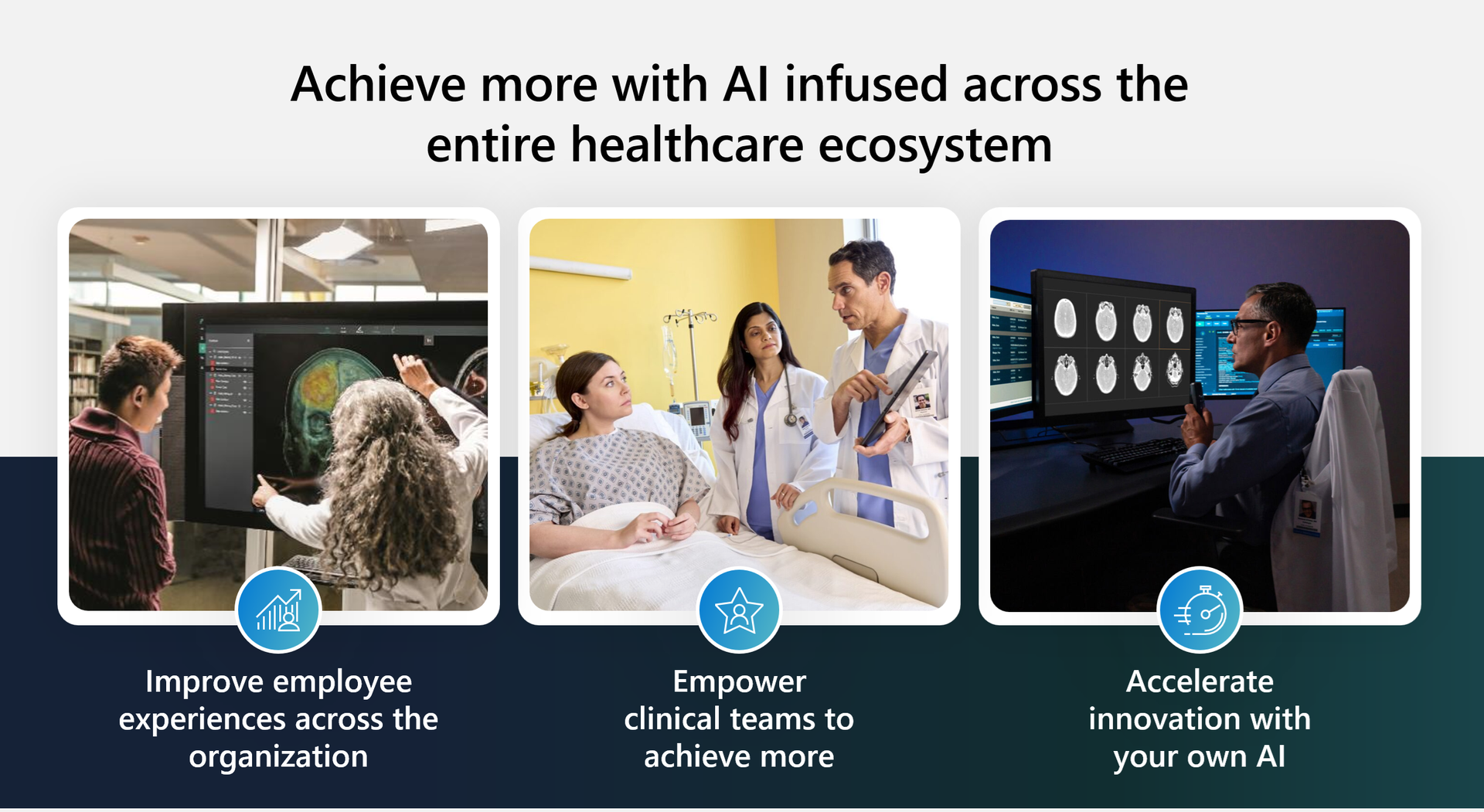
With AI infused across the entire healthcare ecosystem, you can:
Improve employee experiences across the organization.
Empower clinical teams achieve more.
Accelerate innovation with your own AI.
Well-Architected for Microsoft Cloud for Healthcare
The Well-Architected for Industry framework, as described, is a set of guiding principles designed to enhance the quality of industry-specific cloud workloads. It applies the established five pillars of the Microsoft Azure Well-Architected Framework to Microsoft Cloud for industry solutions that helps to produce a high-quality, stable, and efficient industry cloud architecture:
Reliability
Security
Cost optimization
Operational excellence
Performance efficiency
The following diagram gives a high-level overview of Well-Architected Framework pillars and investment areas:

Well-Architected for Industry supporting elements
The six supporting elements of Well-Architected for Industry include:
Reference architecture - A tailored blueprint for Microsoft Cloud industry-specific solutions.
Design principles - Guidelines for constructing solutions using Microsoft Cloud for industry applications.
Best practices - Recommendations for designing, launching, and managing operations.
Checklists - Tools to evaluate the design, rollout, and functioning of industry cloud tasks.
Documentation - References for technical manuals and details.
Partner solutions, support, and services offers - Information on non-Microsoft integrations, technical advice, and associated support and service propositions.
Well-Architected for Healthcare
Well-Architected for Industry guidance is available to help organizations build Microsoft for Healthcare and Life sciences workloads using proven best practices and scalable principles for cloud adoption and governance. In this way, they, too, are more reliable, secure, cost-optimized, operationally excellent, and performant.
Actionable and simple-to-use technical resources are available to guide implementation teams to know where to focus as they adopt Cloud for Healthcare solutions, including:
Implementation recommendations (design, deploy, monitor)
Assessment tool
Reference architectures are available for the following cloud-based solutions offered as part of Microsoft Cloud for Healthcare:
The following diagram shows the solution architecture for Care Management:

The following diagram shows the solution architecture for Patient Outreach:

The following diagram shows the solution architecture for Patient Service Center:

For more information, see Well-architected for Microsoft Cloud for Healthcare.